
Marine diesel engines often originate from commercial vehicle engines (trucks, excavators) – they are fundamentally robust, but one of the main causes of failure is lack of use. If a boat engine is rarely run, the raw water impeller can seize up or belts can harden, for example. In addition, long periods of running at low revs lead to so-called “glazing” (polishing of the cylinder interior surfaces) – modern oils help, but ideally the engine should be run regularly at moderate loads. Another point: installation and marinization (adaptation to the boat) can make accessibility, maintenance, and diagnostics more difficult – it is advisable to familiarize yourself with the engine in advance at the harbor.
Pre-start checks
The following checks should be made before each trip or every morning on tour:
- Visual inspection – Loose or fallen parts, visible leaks, condition of the battery and cables. The engine compartment should be kept clean so that new leaks can be spotted quickly.
- Raw water inlet (seacock, etc.) – Must be open when the engine is running so that cooling water can be drawn in.
- Raw water filter – Remove with seacock closed, check for contamination. If full of dirt/algae, clean and open seacock briefly to flush.
- V-belt – Check the alternator belt, for example, to ensure it is in good condition and has the correct tension. The test: Turn the fan/alternator by hand – it should be difficult to turn and the belt should rotate reliably.
- Expansion tank – Check coolant level: unscrew the cap, place your finger on the rim; the coolant should be at about this point.
- Engine oil – Check oil level with dipstick: first pull it out and clean it, then reinsert it and check. The level should be at the upper mark.
- Transmission oil – Check this as well, but depending on the design, it is often more difficult to access.
- Fuel filter – Check the filter, including the water separator; the diesel should look clean, with no unwanted residues or “diesel bug.”
- Fuel – Check the tank contents, paying particular attention to using marine diesel if possible (lower bio content, less water).
- Driveshaft coupling – Check the connection between the engine/transmission and the propeller shaft: Check that the bolts are tight, turn the propeller shaft by hand – there should be smooth, even resistance, no blocked areas.
- Engine mounts – Mounting points are the connection between engine thrust and the boat. Visual inspection for signs of movement (“skating marks”). Check bolts/grooves and retighten if necessary.
- Throttle and gear linkages – Check the Bowden cables/control cables: securely mounted, no corrosion, so that there is no sticking in forward or reverse gear.
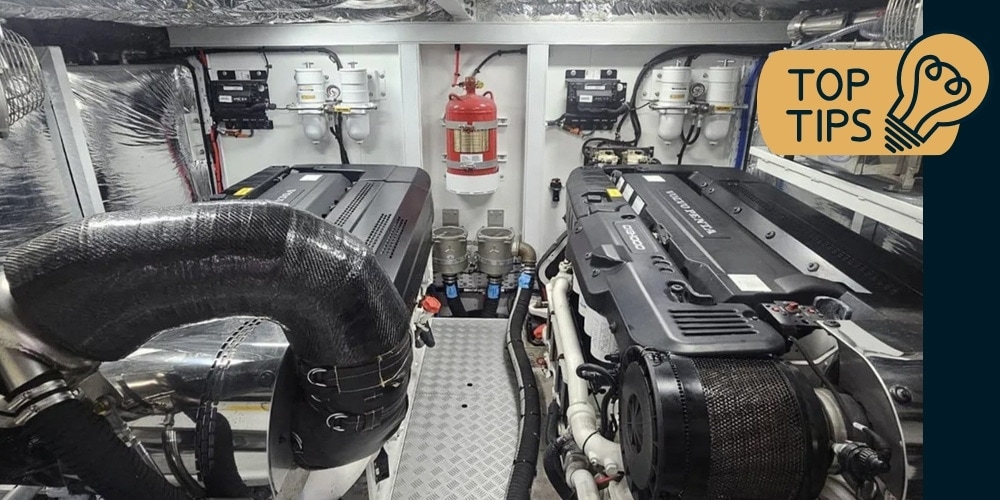
Start procedure
The following points are important when starting:
- Set the ignition to the preheat position (“glow plug”) and wait 10–15 seconds.
- The indicator lights should come on when the key is in the preheat position: oil pressure, temperature, voltage, etc.
- All lights should go out after starting. A short burst of black or white smoke is normal, but it should disappear quickly.
- Check: Voltage >12 V (for 12 V system), raw water drain visible? If no coolant is coming out of the exhaust → stop immediately!
- Warm up the engine: approx. 30 minutes. Operating temperature typically approx. 80–82 °C.
- Check fuel cap/seals: Grease O-ring, keep clean – to prevent water from entering the fuel.
Diagnosis of common problems 🛑
Some typical scenarios with causes:
- Engine won’t start: e.g., dead battery or no connection; air in the fuel system (“air lock”) – bleed correctly; defective glow plugs.
- Overheating: No coolant flow – e.g., strainer clogged, impeller damaged; coolant loss in the expansion tank due to leaky line.
- Loss of power: Propeller wrap – foreign objects or rope around propeller; air filter blocked; sight, belt, and bearing problems.
- Smoke: Blue = worn piston rings/cylinders; black = excessive injection; white = unburned fuel or condensation in cold weather.
- Vibrations: Many causes – air in the system, cylinder problem, engine mounting error, damaged propeller blade.
Assembly/installation instructions
This is particularly true for older sailing yachts: the engine compartment can be cramped and difficult to access. Important components (e.g., impeller housing) should be accessible. If not, install inspection hatches or make adjustments.
Simple tips and practices ✅
- Do not start the engine with the dipstick removed.
- If the dipstick is difficult to access, secure it with string so that it does not lie in the bilge.
- Grease screws and nuts or protect them with Vaseline.
- Do not force parts into place – if something does not fit by hand, it is probably installed incorrectly.
- Empty your pockets (e.g., glasses) before leaning over the engine.
- When working: Remove the ignition key and place it out of reach so that no one can start the engine accidentally.
You may also be interested in: