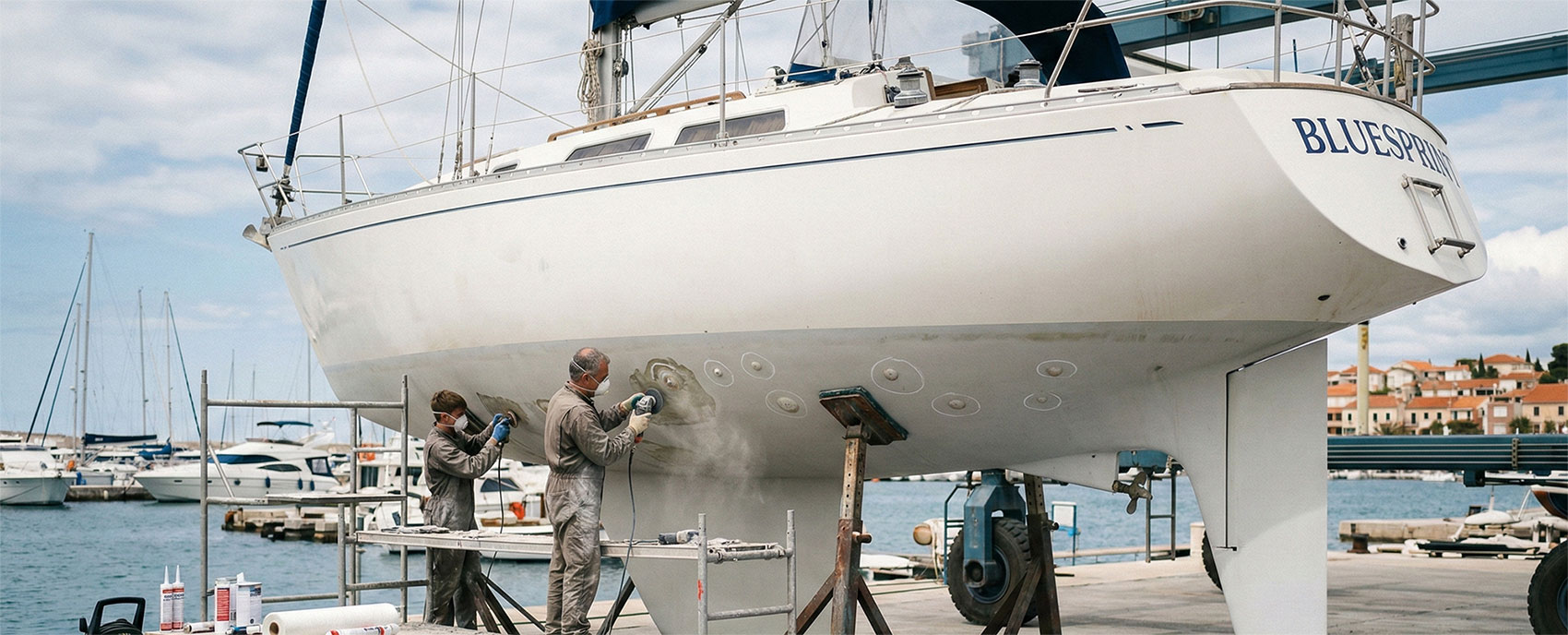
The yachting season is approaching – and now is the right time to address an issue that many owners initially choose to ignore: osmosis in GRP hulls.
If osmosis is detected too late, repairs can be so time-consuming that your boat will not be ready to launch in time for the start of the season. That is precisely why it is worth checking early on.
🔬What is osmosis on the hull?
Osmosis describes a physical-chemical process in which water penetrates through the gelcoat into the laminate of the GRP hull.
Inside the laminate, the penetrated water reacts with certain resin or soluble components. This produces liquids with increased concentration, which promote further water ingress. Pressure builds up – and this pressure leads to the typical blisters under the gelcoat.
In short:
Water penetrates → chemical reaction occurs → pressure builds up → bubbles form.
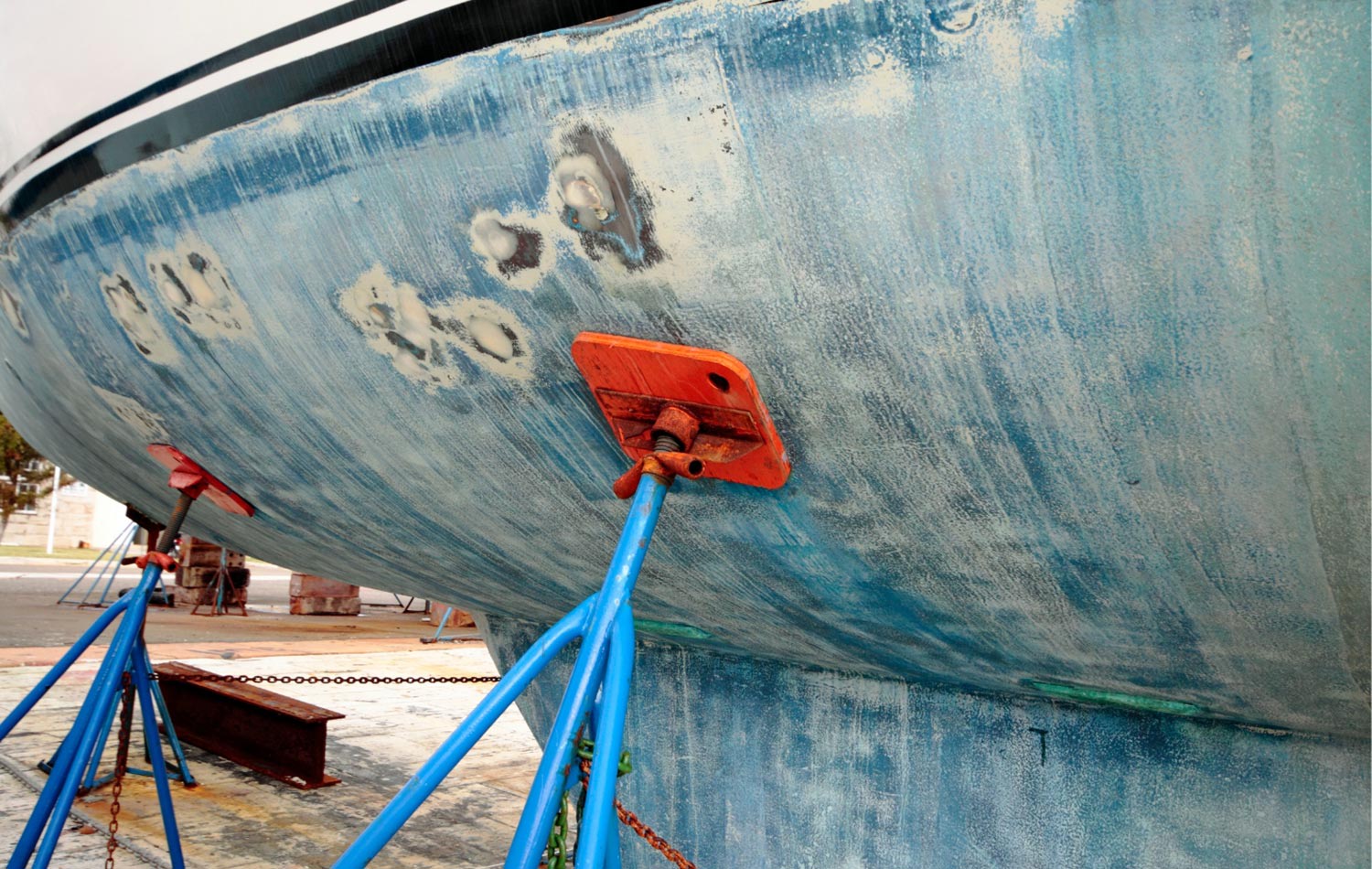
🔎 How can you recognize osmosis?
Typical signs are usually found in the underwater hull:
- Bubble formation
Small to large bubbles in the gelcoat, often in areas permanently exposed to water. - Liquid leakage
When the blisters are opened, a brownish, sour-smelling liquid often leaks out – a classic indication. - Blisters that appear to have “disappeared” in winter
Blisters can dry out and become less visible during winter storage. However, they often reappear after renewed contact with water.
Important: Not every unevenness automatically means osmosis. Processing errors, inclusions, or antifouling problems can also cause similar phenomena. A professional diagnosis is therefore crucial.
⚠️ Why is early diagnosis so important?
Osmosis does not disappear on its own. Without treatment, it can:
- Further moisture penetrates the laminate.
- The structure is weakened in the long term.
- The cost of renovation increases significantly.
Repairs are costly and usually include:
- Removal of old coatings
- Exposure of affected areas
- Intensive drying phase (several weeks to months possible)
- Reconstruction with epoxy systems and subsequent protective coating

Those who react too late risk that the work cannot be completed in time before the season starts.
🔎 Professional moisture measurement: Gain clarity quickly
Not all osmosis is immediately visible. Often, an increased moisture level in the laminate becomes apparent before bubbles form. This is precisely where professional measurement comes in.
We work with a special moisture meter for GRP hulls that measures non-destructively. For you, this means:
- No damage to the surface
- Fast measurement directly on the hull
- Immediate assessment of moisture conditions
- Objective basis for further decisions
Within a short period of time, it can be determined whether your hull is uncritical or whether action needs to be taken.
If you are thinking about selling your boat, planning a long trip, or simply want to start the season safely, a thorough inspection will give you peace of mind. Instead of waiting or reacting to visible signs of damage, you can take proactive measures—quickly, easily, and professionally.
📅 Check now
Now—before the start of the water season—is the ideal time for an inspection. A professional measurement provides clarity—before a minor finding turns into a major renovation project.
🛡️Osmosis protection: prevention rather than cure
Especially if your boat shows no or only slight signs of osmosis, it is worth considering how you can protect the hull from moisture penetration in the long term. Consistent osmosis protection can help to significantly slow down the process of water ingress in the long term and permanently stabilize the laminate – ideal if you are planning long periods of storage in the water, winter storage, or blue water cruising.
🧱 Build up a protective layer
After inspecting the underwater hull, osmosis protection can be installed without the need for complete refurbishment. This usually involves removing the existing coating down to the gelcoat. The hull is then rebuilt to create a permanent barrier against moisture.
There are different variants depending on the procedure:
1. Sand down to the gel coat:
The existing coating is carefully removed down to the gelcoat. The underwater hull is dried and then coated with thick layers of epoxy coating. This barrier layer acts as a moisture barrier and significantly reduces water ingress.
2. Intensive shot blasting process:
This involves deliberately exposing any cavities between the gelcoat and laminate before the hull is thermally dried and epoxidized. This method also serves to provide targeted protection against water ingress at a later stage.
3. Sanding down to the laminate:
If the gelcoat is already damaged, it is completely removed and the hull is prepared down to the laminate. After drying, the laminate is thermally dehumidified and rebuilt with high-quality material. This option provides a very high standard of protection, especially for planned longer periods of storage in the water.

🛠️ Effect and goal
The aim of all these processes is to minimize water ingress into the GRP laminate in the long term, thereby reducing the risk of osmosis. As a general rule, the thicker and more homogeneous the protective layer (e.g., epoxy primer or barrier coating), the better the laminate is protected against moisture ingress.
While high-quality osmosis protection cannot prevent every single cause of moisture absorption, it does significantly reduce the risk of osmosis later manifesting itself in a visible and expensive renovation.