
The time has finally come: The purchase agreement has been signed, and your own boat or dream yacht is ready and waiting. But before you can cast off and sail off into the sunset, there’s still a bit of paperwork to take care of.
The question “Where and how do I register my boat?” is one that almost every boat owner asks. In this guide, you’ll learn, step by step, how to register your boat in Germany and what special requirements apply if you want to use or register your yacht permanently in Croatia or Spain (Mallorca).
Register a boat in Germany 🇩🇪
Do I have to register every boat? (The registration requirement)
The short answer is: No, but the majority of them do.
Whether registration is required, however, depends primarily on engine power, boat type, and the area in which the boat is operated. In Germany, there is a legal requirement for small vessels to be registered on inland waterways. A boat must therefore be registered if:
• It has an engine power of more than 2.21 kW (3 PS)
• It is a sailboat without an engine with a hull length of more than 5.50 meters.
Exception: Rowing boats, kayaks, or small motorless dinghies that are less than 5.50 meters long generally do not require an official registration number. However, registration (e.g., as proof of ownership in the event of theft) does no harm in this case either.

Where can I register my boat or yacht?
There are several options for registering your boat in Germany. Depending on where you plan to sail, different documents may be required:
1. The waterways and shipping authority (WSA)
- Document: Certificate of small vessel registration
- Suitable for: Boat owners who wish to officially register their boat and who primarily sail on German inland and coastal waters.
- Advantage: The registration remains valid as long as the registration requirements are met. Any changes in ownership or to key boat information must be reported to the issuing authority.
2. The German motor yacht association (DMYV/GMYA) / German sailing association (DSV/GSA)
- Document: international boating license (IBS/IBL)
- Perfect for: Skippers who also sail abroad (e.g., Croatia, Italy, the Netherlands).
- Disadvantage: The international boating license (IBS/IBL) is issued for a limited period and must be renewed regularly. You should check the current validity period with the issuing association.
3. The maritime register (for large yachts)
- Document: Ship certificate
- Perfect for: Large yachts and seagoing vessels. For larger seagoing vessels, registration in the seagoing vessel register may be required or advisable. The requirements are based on legal provisions and should be reviewed on a case-by-case basis.
- Advantage: It is internationally recognized as a particularly credible proof of ownership and allows the holder to fly the federal flag.
Checklist: What documents are required?
To ensure that your application is processed without delay, please have the following documents ready:
• Identification card (copy of front and back)
• Sales contract or invoice (as proof of ownership)
• CE Declaration of Conformity: Required for many motorboats and sailboats.
• Technical specifications of the boat and engine (manufacturer, serial number/HIN, length, width, draft, engine power)
• Photos of the boat (often required by the WSA to identify the model)
• Confirmation of deregistration, if applicable, if the boat was previously registered to another owner.
How long does it take to register a boat?
Depending on the agency and the time of year, processing times typically range from a few days to several weeks. During the peak season in the spring, processing times may be longer.
How much does it cost to register a boat?
The costs depend on the type of registration and the responsible authority. Fees for an official license plate or an international boat registration certificate typically range from 20 to 50 euros. In addition, there may be costs for license plate lettering and subsequent changes.

Step-by-step guide to registering a boat
Step 1: Choose the right government agency
For most beginners, visiting their local WSA or submitting an online application to the DMYV/DSV is the fastest way. Many WSAs now offer the option to register conveniently online.
Step 2: Gather and submit documents
Fill out the application form completely. Important: Be extremely careful to ensure that the engine number and the hull identification number (HIN/CIN) match exactly the physical numbers on the boat.
Step 3: Attach the license plate
As soon as you have your boat license in hand, you will be assigned a registration number. This must be affixed permanently and legibly in a light color on a dark background (or vice versa) to the bow or stern of the boat. The exact requirements regarding size and design are governed by the applicable regulations.
Important additional information: Insurance and radio
Simply registering the boat is often not enough. The following points are also important:
• Boat liability insurance: While it is not (yet) mandatory in Germany, it is strongly recommended. In many countries and sailing areas (e.g., Italy or Croatia), it is also required by law.
• Frequency allocation (Federal Network Agency): If your yacht is equipped with a VHF radio, it must be registered separately with the Federal Network Agency. You will also need the appropriate radio certificate (SRC/UBI) for this.
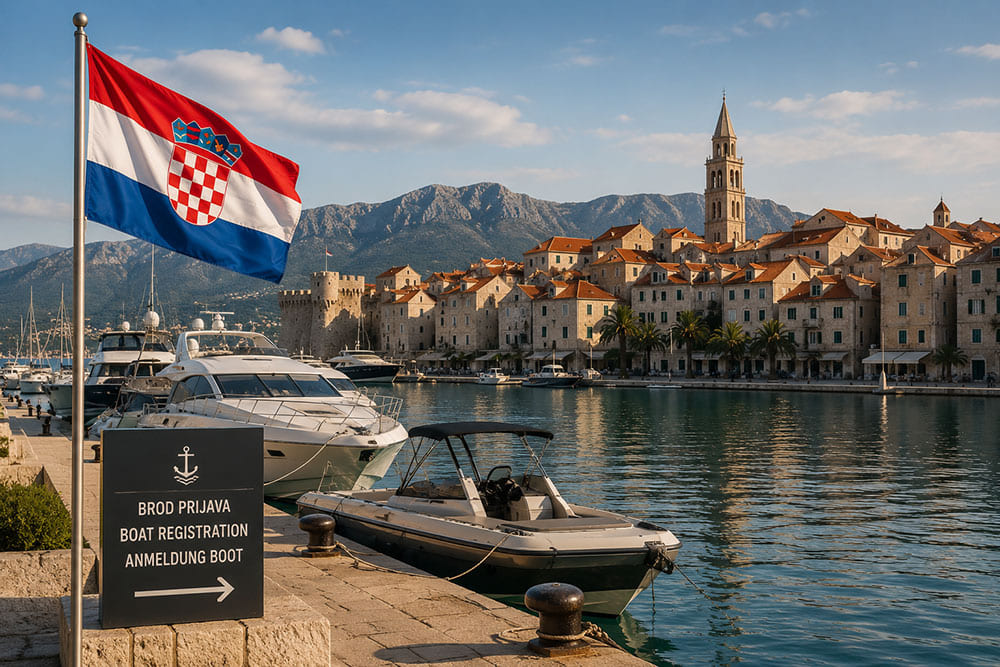
Register a boat in Croatia 🇭🇷
Croatia is one of the most popular boating destinations in Europe. Many of our customers pick up their new boats directly at our location in Tribunj.
Important to know:
• German boat owners can generally continue to sail their boats under the German flag.
• Anyone who has a permanent berth in Croatia or wishes to register a vessel under the Croatian flag must comply with Croatian registration regulations.
• In addition, Croatian navigation and administrative fees may apply.
Registration under the Croatian flag is generally also possible for foreign owners. Requirements include, among other things, proof of ownership (e.g., a bill of sale), a certificate of deregistration from the previous registration (if available), the CE Declaration of Conformity or the required technical documentation for the boat, and proof of valid insurance. Depending on the boat’s length, registration takes place either with the relevant port authority or – for larger yachts – in the Croatian Ship Register. For boats with a propulsion power exceeding 15 kW, liability insurance is also required by law.
Required documents
- Boat registration
- Proof of ownership
- Proof of insurance
- Identification card or passport
- Boat license (depending on the boat)
- Radio license for VHF radio
Tip: If you pick up your boat at our location in Croatia, we’ll help you prepare the necessary documents upon request and, of course, guide you through the registration process.
Now nothing stands in the way of yachting in Croatia!

Register a boat in Spain (in Mallorca) 🇪🇸
Mallorca is one of the most popular sailing destinations in the Mediterranean and, for many yacht owners, the perfect location for their own yacht. The combination of a pleasant climate year-round, excellent infrastructure with numerous marinas, and proximity to the other Balearic Islands makes the island particularly attractive.
The following applies to German owners:
- A German license plate or an IBS is generally recognized.
Anyone who wishes to keep their boat permanently in Spain or sail under the Spanish flag must comply with Spanish registration regulations. Whether Spanish registration is required depends, among other things, on the owner’s place of residence, the length of time the boat will be used in Spain, and the planned home port.
The following documents are generally required for registration:
• Proof of ownership (purchase agreement or invoice)
• Proof of previous registration or cancellation of registration (if applicable)
• CE declaration of conformity or technical boat documentation
• Passport or ID card
• Valid proof of insurance
• Technical specifications of the boat (length, width, draft, engine)
• If applicable, proof of taxes and fees paid
Depending on the type of boat and its intended use, technical inspections or safety inspections may also be required. Boats flying the Spanish flag must comply with national equipment and safety regulations. These include, among other things, the required safety equipment as well as – depending on the area of operation – lifesaving equipment, signaling devices, and radio equipment.
Also important
Many marinas require the following even before a contract is signed:
- Boat registration
- Berth contract
- Proof of insurance
- Proof of ownership
- Technical specifications of the boat
- A port registration does not replace the actual boat registration
Differences between Germany, Croatia, and Spain
| Germany | Croatia | Spain | |
|---|---|---|---|
| Registration | Registration via WSA or IBS | German registration is recognized; Croatian registration is possible for vehicles permanently stationed in Croatia | German registration is recognized; Spanish registration is possible for vehicles permanently stationed in Spain |
| Labeling requirement | Mandatory labeling based on engine power or boat length | National regulations for ships with Croatian flags | National regulations for ships with Spanish flags |
| Insurance | Liability insurance recommended | Required for many boats | Required for many sport boats |
| Radio system | Registration with the federal network agency | Observe the radio license requirements and Croatian regulations | Observe the radio license requirements and Spanish regulations |
Conclusion:
Registering a boat or yacht isn't rocket science, but it does require a bit of care when it comes to the paperwork. If you get your documents in order ahead of time, you'll usually have your registration number in hand within a few days or weeks. After that, all that's left to do is apply the antifouling, stick on the registration number, and head out onto the water!
Do you have questions about registration, or are you still looking for the right insurance for your new boat? Contact our team!